
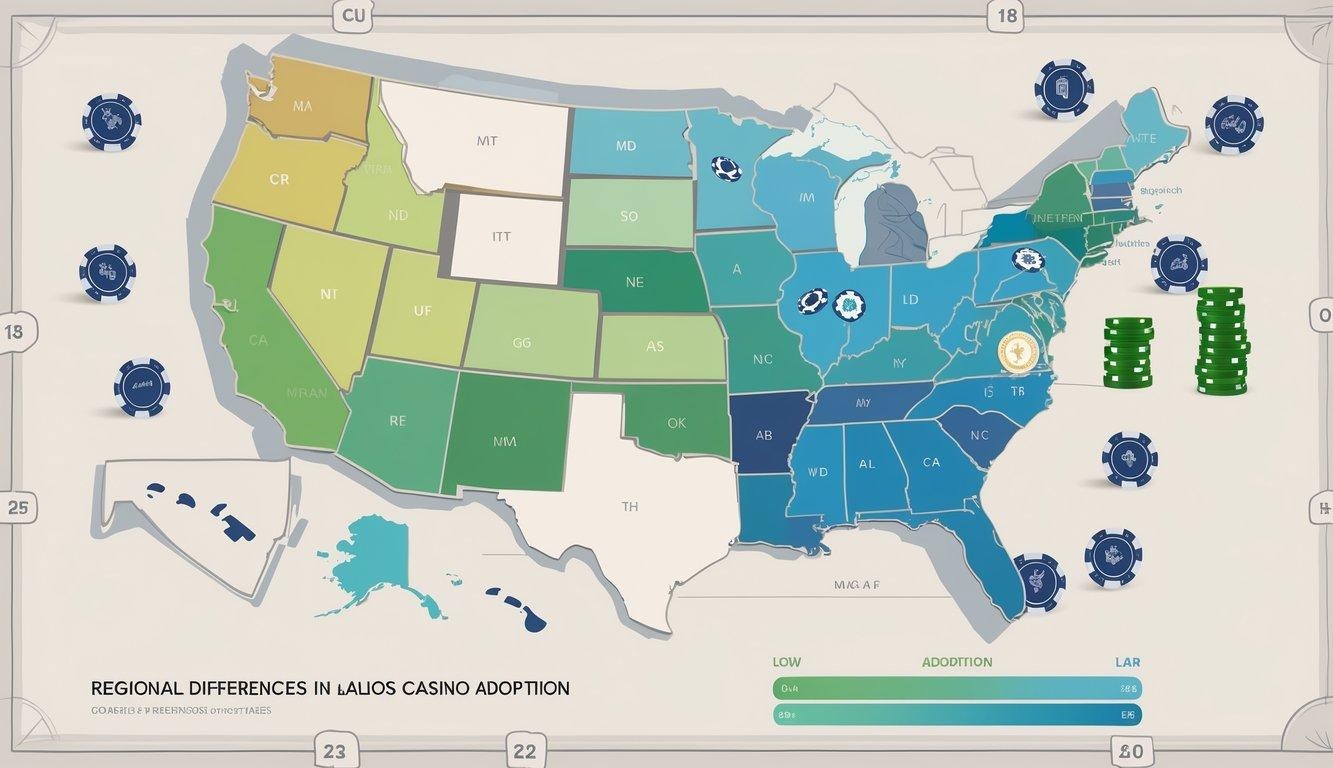

Casino adoption across the United States looks dramatically different depending on where you stand. Some states have embraced commercial and tribal casinos, sports betting, and online gaming platforms, while others maintain strict prohibitions or offer only limited options. These differences create a complex patchwork of gaming availability that directly affects what you can access in your region.
The variation in casino adoption stems from distinct historical, cultural, legal, and economic factors that shape each state’s approach to gaming. Understanding these regional patterns helps explain why Nevada’s casino-saturated landscape differs so vastly from Utah’s complete prohibition, or why Michigan offers comprehensive online gaming while neighboring states restrict it. The economic impact is substantial, with the gaming industry generating $115 billion in gross gaming revenue in 2024 and supporting 1.8 million jobs nationwide.
Your experience as a casino player or industry observer depends heavily on your location. Regional differences extend beyond simple availability to influence the types of games offered, player motivations, and how gaming revenue supports local communities through tax contributions and job creation.
Key Regional Differences in Casino Adoption
Casino adoption across the United States reflects distinct geographic patterns shaped by state legislation, economic motivations, and tribal sovereignty agreements. Nevada pioneered commercial casinos in the 1930s, followed by New Jersey in 1976, while most states legalized casino gaming after the late 1980s through varying combinations of commercial and tribal operations.
Historical Evolution of Casino Legalization by Region
Nevada stood alone as the only state with legalized commercial casinos from 1931 until New Jersey voters approved Atlantic City casinos in 1976. This regional monopoly ended dramatically in the late 1980s when the Supreme Court ruling in California v. Cabazon Band of Mission Indians (1987) and the subsequent Indian Gaming Regulatory Act (1988) opened pathways for tribal casinos nationwide.
Iowa became the third state to legalize commercial gaming in 1989, triggering a regional wave across the Midwest and South. Riverboat states including Illinois, Indiana, Louisiana, Mississippi, and Missouri introduced casino gaming in the early 1990s, often restricting operations to waterways. Maryland didn’t legalize commercial casinos until 2008, while Virginia approved casino development in four cities through a 2020 referendum.
The Fifth Federal Reserve District exemplifies this delayed adoption pattern. As of 2021, the region operated only 11 commercial casinos across Maryland and West Virginia, plus three tribal casinos in North Carolina. This stands in stark contrast to more established markets that developed decades earlier.
Commercial and Tribal Casinos: State-by-State Comparison
As of 2022, commercial casinos operate legally in over 30 states, coexisting with more than 500 tribal casinos nationwide. The distribution creates significant regional disparities in casino availability and market structure.
Key differences between casino types:
- Commercial casinos require state legislation and operate under higher tax rates, typically applied to net gambling amounts rather than profits
- Tribal casinos operate on federally recognized tribal lands under state-tribal compacts with different regulatory frameworks
- Tax structures vary widely, with Nevada and New Jersey maintaining lower gaming tax rates due to their established markets
States like Oklahoma and California host numerous tribal casinos but limited or no commercial operations. Conversely, states such as Maryland operate exclusively commercial casinos. Pennsylvania developed both commercial and tribal casinos after the mid-2000s, creating competitive regional markets.
Non-Native American casinos tend to locate near large populations across state borders, allowing them to capture cross-border gambling revenue. This proximity to state lines creates competitive advantages in attracting “export taxes” from out-of-state tourists.
Major Casino Hubs: Las Vegas, Atlantic City, and Emerging Markets
Las Vegas remains the dominant casino market in the United States, benefiting from decades of infrastructure development and its status as an international entertainment destination. The city’s casino gaming landscape evolved from its 1930s origins into a diversified resort economy.
Atlantic City represented the East Coast’s monopoly on commercial casino gaming from 1978 until the 1990s. Payroll employment in the Atlantic City metropolitan area more than doubled in the ten years following the opening of Resorts International in 1978. However, casino expansion in neighboring states including Delaware, Pennsylvania, Maryland, and New York eroded this regional monopoly significantly.
Market saturation now defines mature casino regions. When you examine emerging markets, you’ll find they face different challenges than historical hubs. Virginia’s approved casino locations in Bristol, Danville, Norfolk, and Portsmouth target economic development in smaller cities. Research indicates casino development benefits rural and less-populated counties more substantially, with employment effects inversely related to population density.
The Mississippi River corridor created a distinct casino development pattern, with riverboat gambling shaping the spatial evolution of the industry across multiple states.
How Regional Factors Influence Casino Formats and Impacts
Regional characteristics shape not only whether states adopt casino gambling but also what types of gaming operations emerge and how they affect local economies. Population density, geographic features like the Mississippi River, and varying state tax structures create distinct gaming markets with different economic outcomes and player preferences.
Economic Consequences and Casino Tax Revenue Differences
Casino tax revenue varies dramatically across states based on regional market conditions and tax structures. Nevada and New Jersey, with established gaming markets, maintain lower gaming tax rates while newer markets often impose higher rates to maximize immediate revenue. Gaming taxes typically apply to the net amount gambled rather than profits, distinguishing them from standard corporate taxes.
The Federal Reserve Bank of Richmond’s Economic Brief notes that despite tax revenue being a primary motivator for state legalization of casinos, there is little evidence that commercial casinos boost overall state tax revenues. Substitution effects play a key role: when consumers patronize newly opened casinos, they often reduce spending on existing gambling options like lotteries and horse racing, as well as other goods and services that generate state tax revenue.
Population density significantly affects economic outcomes. Smaller counties and rural areas experience more pronounced employment and income benefits from casino development compared to urban locations. Per capita income, labor force participation, and unemployment rates improve more substantially in less dense regions. However, casino revenues decline when competing casinos open in neighboring counties, creating market saturation that diminishes regional economic benefits.
Gaming Preferences, Game Types, and Player Behavior by Region
Regional differences in gaming preferences reflect demographic characteristics and cultural attitudes toward specific games of chance. Urban markets typically support higher concentrations of table games like poker and blackjack, attracting players seeking skill-based gaming experiences. Rural and riverboat casinos often emphasize electronic gaming machines, which require less floor space and staffing while generating consistent revenues.
Player behavior varies by regional economic conditions and available disposable income. Higher-income urban areas see more frequent casino visits with larger individual wagers, while lower-income regions show different spending patterns focused on electronic gaming machines with lower minimum bets.
The proliferation of online gambling and sports betting has created new regional disparities in gaming preferences. States that legalized online casinos and sports betting platforms see shifts in player behavior, with younger demographics preferring mobile gaming options. As of May 2022, sports betting is legal in 35 states plus the District of Columbia, creating varied market conditions based on state regulations and technological infrastructure.
The Role of State Regulations in Online Gambling and Sports Betting
State regulations create fragmented markets for online gambling and sports betting following the 2018 Supreme Court decision in Murphy v. National Collegiate Athletic Association. This ruling overturned the 1992 Professional and Amateur Sports Protection Act, enabling states to independently legalize sports betting. Regional differences in regulatory approaches determine market accessibility and consumer options.
Some states permit full-scale online casinos offering poker, blackjack, and electronic gaming machines, while others restrict online gambling to sports betting only. These regulatory choices reflect regional attitudes toward commercial gaming and concerns about problem gambling. States with existing land-based casino infrastructure often adopt more restrictive online gambling policies to protect casino revenues from cannibalization.
Improved technology enabled the introduction of online gambling in several states during the mid-2000s through mid-2010s. However, technological capabilities vary by region, with rural areas facing infrastructure limitations that affect online casino and sports betting participation rates. State licensing requirements, tax rates on online gaming, and interstate compacts for shared player pools create additional regional variations in market structure.
Are Arkansas Online Casinos Legal?
For many observers, is online casino legal in Arkansas? remains a useful question because it captures how uneven gambling regulation still is across the United States. While some states have built fully regulated online gaming markets, Arkansas still sits outside that model and does not currently offer a legal framework for statewide online casino play.
That contrast helps explain the broader regional divide. In states such as New Jersey, Michigan, and Pennsylvania, online casino gaming developed as an extension of already established gambling policy, while Arkansas remains in a more restrictive position where digital casino expansion is still tied to legislative uncertainty.
The difference affects more than player access alone. It also shapes regulatory oversight, tax potential, consumer protection standards, and the likelihood that residents in more restrictive states will look beyond locally regulated options.
Social Contexts: Urban, Rural, and Riverboat Casinos
Casino formats respond to distinct social contexts across urban, rural, and riverboat settings. Riverboat casinos emerged in Mississippi River states (Illinois, Indiana, Iowa, Louisiana, Mississippi, and Missouri) during the 1990s, shaped by state laws requiring gaming operations on navigable waterways. These facilities serve regional populations and attract tourism to areas with limited entertainment options.
Urban casinos integrate into existing entertainment districts, competing with sports arenas, theaters, and restaurants for consumer spending. The local impact of casinos in dense urban areas is limited because residents have numerous alternative entertainment options. Rural casinos function as primary entertainment destinations, generating more significant employment effects relative to the local population.
Problem gambling rates and associated social costs vary by regional context. Research indicates that gambling, particularly problematic gambling, correlates with risky behaviors including binge drinking and substance use. Less-populated counties with casinos experience higher rates of alcohol-related fatal traffic accidents compared to urban areas with multiple entertainment venues. Between 0.4 and 2.0 percent of the population suffers from problem gambling, with costs affecting individuals, families, employers, and communities through lost income, decreased productivity, and strain on public services.